The Ocelot in Costa Rica
Deep in the Costa Rican rainforest, where sunlight is scarce and all manner of jungle sounds echo through the trees, lives an animal that you almost never see, but which helps maintain the balance: the ocelot. And, not least, a resident of the Adopteer Regenwoud reserve.
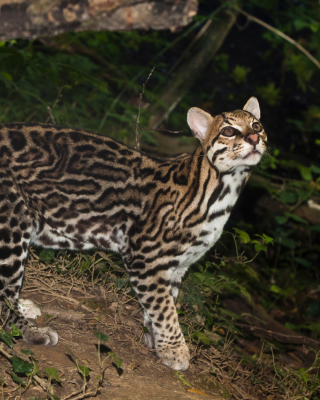
The ocelot, scientific name Leopardus pardalis, is one of the six feline species found in Costa Rica. This animal is a medium-sized feline found in Central and South America. At first glance, you might draw parallels with a large domestic cat, but make no mistake. They bear some resemblance to jaguars, but are much smaller. The name ocelot derives from the Aztec word tlalocelot, meaning ‘field tiger’.
It moves through the forest like a shadow. Silent, calculated and completely at one with its surroundings. No show, no spectacle. Just a hard–working hunter. Perhaps that is precisely why it is so important.
A predator that needs space
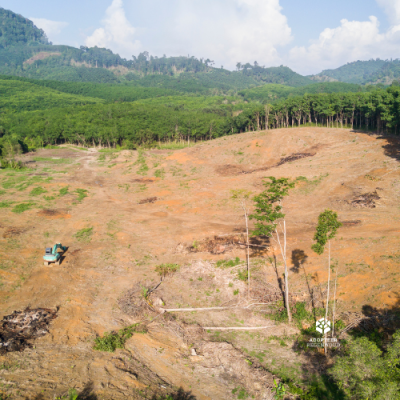
The ocelot lives in dense rainforests and jungle areas – places where it can disappear into the foliage and where there is plenty of prey to be found. The ocelot’s range comprises a variety of habitats, but they prefer densely vegetated areas such as lush forests and environments with fresh water. In Costa Rica, the ocelot is still relatively common. But that does not mean it is safe. On the contrary: its habitat is shrinking and becoming fragmented due to deforestation, agriculture and infrastructure. And that is where the problem begins. A male ocelot can have a territory of up to 30 square kilometres. It needs space to hunt, move around and find a mate.
Unfortunately, if we do nothing, that space may disappear. Forests are being cut up into smaller patches. Roads are cutting through habitats. Agriculture is encroaching. The result? A hunter trapped within its own territory. Even the best hunter cannot survive in a world that is falling apart.
Appearance
Ocelots grow to around 80 cm in length and 40 cm in height. Their short coat ranges from golden brown to pale yellow, with a pattern of black rosette-like spots. The pattern on their backs is as unique as a human fingerprint. This predator may well have the most beautiful coat of all wild cats. A golden-yellow base with black rosettes and stripes, a unique pattern. This is no coincidence; it is strategy. In the filtered light of the rainforest, its coat acts as a cloak of invisibility. You could stand a few metres away and still not see it. The reverse is not true, however, as it can see you. Always.
The ocelot has a fairly broad but short tail, measuring between 26 and 42 cm, which ends in a black tip, and weighs between 7 and 15 kilograms. At this weight, it is larger than a domestic cat, but small enough to move nimbly through the dense forest. A perfect balance between strength and flexibility.
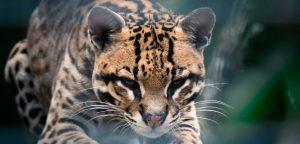
In Costa Rica, the ocelot is known as the ‘Manigordo’, or ‘big paw’. Not the most elegant nickname, but certainly an apt one. These cats have relatively large paws. That is why they are also known locally as manigordo. Their large paws give them grip on muddy forest ground, ensure silence whilst stalking, and make them precise when attacking. The tracks they leave behind are about 5 to 6 cm in size.
Nightly hunter
The ocelot comes to life when the jungle sleeps. It is primarily nocturnal, but also ventures out at dusk. With exceptional night vision and keen senses, it hunts rodents, birds, reptiles and small mammals. The ocelot eats around 7% of its body weight daily and is not a fussy eater, but an efficient one. These active hunters are known for first removing the fur or feathers from their prey before eating it. Sometimes they even dare to take on larger animals, such as collared peccaries, tamanduas and kinkajous. In addition, there have been observations of ocelots mimicking the calls of birds, such as tinamas, to lure prey.
He waits, observes and strikes in the right moment. Somtimes in minutes, somtimes in hours. Patience is his strength.
Ocelots spend most of their time on the ground, but are also adept at climbing and swimming. They cover 5 to 7 kilometres per night, mostly on their own. They are solitary animals and only seek out conspecifics during the mating season. Young remain with their mother until around two years of age before seeking out their own territory. The territory is marked with scent trails of urine and faeces. It is striking that they use communal latrines. These scent marks convey important information, such as the presence of other ocelots, gender, age and reproductive status.
Fragmentation of a healthy ecosystem
The ocelot is not only a hunter, but also a vital link in the ecosystem. By keeping populations of smaller animals in balance, it prevents the ecosystem from spiralling out of control. Without predators such as the ocelot, certain species can multiply explosively, with all the consequences that entails for the flora and fauna in the food chain. Where the ocelot lives, the forest thrives. The presence of ocelots tells us something important: the ecosystem appears to be functioning. There is sufficient food, enough shelter and an intact habitat. That is why the ocelot is regarded as an indicator species. Do you see ocelots? Then there is a good chance that the local rainforest is healthy. Are they disappearing? Then that is often a sign that something is going wrong.
In the past, the ocelot fell victim to large-scale trade. Due to their beautiful fur and compact size, they were heavily hunted for the fur industry or kept as exotic pets. As a result, they are now almost extinct in North America. Fortunately, this trade has since been banned. Yet the greatest threat today lies elsewhere: habitat fragmentation. Without connectivity, isolated populations arise. Without gene flow, populations weaken. And without healthy populations, the species slowly disappears from the landscape.
Why protecting rainforest makes the difference

Protecting the ocelot does not start with the ocelot itself, but with protecting its habitat. At Adopteer Regenwoud, we are working hard to achieve this.
- Purchase of (former) rainforest
- Protection of existing rainforest
- Restoration through measures such as reforestation
- Research into enhancing biodiversity
- This work is carried out by and with the local population
Adopteer Regenwoud takes action
These felines are found in the Adopteer Regenwoud reserve and are a common sight on the wildlife cameras. In recent years, hundreds of sightings have already been recorded in the reserve. The foundation’s work provides these cats with an area to live and reproduce, which is not only beneficial for the ocelot itself, but for the entire ecosystem of which it forms part. You can be part of this, from the comfort of your own home!
By contributing to the protection of the rainforest:
- you help preserve habitats
- you ensure connectivity between nature reserves
- you give animals such as the ocelot a future
It starts small. A patch of forest. A few square metres. But for an ocelot, that can be the difference between a safe route and a dangerous crossing. Adopt your own patch of rainforest and help the ocelot and all the animals and plants around it to live a dignified life!