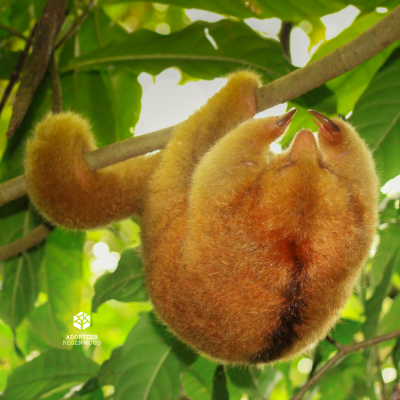
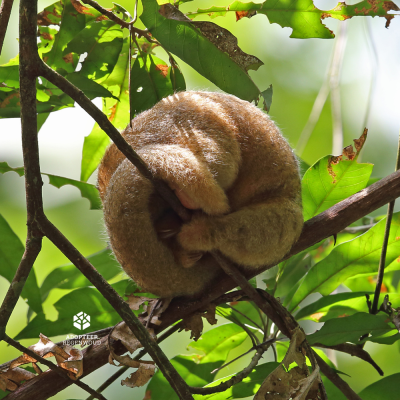
The Costa Ricans call him el serafín del platanar, literally translated: the little angel of the banana plantation. A nickname that perfectly suits his soft fur, calm demeanor, and almost fairy-tale-like appearance. Once you see him, you immediately understand why this little rainforest dweller is called that.
Pygmy Anteater: the Acrobat
Scientifically known as Cyclopes didactylus, it is the smallest anteater in the world. But don’t be fooled by its size. Despite its modest length, the dwarf anteater is fully adapted to life in the treetops of Central and South America. With its prehensile tail, sharp claws, and excellent camouflage, it moves effortlessly through the heights of the rainforest, a mini-Tarzan, as it were.
The dwarf anteater is a true treetop athlete. It spends almost its entire life among the branches, where it can hang upside down with its prehensile tail, which is actually longer than its body. It uses its powerful front legs, equipped with sharp claws, not only to hold on, but also to collect ants and defend itself.
Fun Facts
Extremely difficult to spot!
Length: 16–21 cm (plus another 16–23 cm tail)
Weight: approximately 1.5 to 2.75 kg
Coat: dense and velvety, golden yellow to brownish yellow, sometimes with a dark stripe
Lifestyle: nocturnal, during the day it curls up in tree hollows for a nap
Diet: mainly ants, supplemented with other small insects
Thanks to its warm camouflage color, it blends in almost completely with the greenery. One moment it is there, the next it seems to have dissolved into the canopy. In addition to sharp eyes, you need a dose of luck to spot one.
At home in our reservation
In Costa Rica, dwarf anteaters mainly live in humid lowland rainforests, among the tall trees and lianas, a kind of tropical playground for these animals. Here they find food, shelter, and safe routes through the treetops. Recently, this special species was also spotted in the Adopt a Rainforest reserve. So this little creature is also one of Adopt a Rainforest’s angels. A wonderful sign that our reserve, thanks in part to volunteers and donors, is actually functioning as a habitat for rare animals. Without active protection, animals such as the dwarf anteater are slowly but surely losing their homes. The fact that a dwarf anteater has been spotted in the reserve shows what joint efforts can achieve. But this does not happen by itself. Purchasing and preserving rainforest requires ongoing commitment and necessary support.
By adopting a piece of rainforest, you directly contribute to:
protecting animals such as the dwarf anteater
combating deforestation
preserving biodiversity for future generations
The dwarf anteater may be small, but its story symbolizes something big: we can only do this together. Every contribution counts. This is how we ensure that these silent tree acrobats, and all other inhabitants of the rainforest, will still have a place to live in the future. And we’re not just doing it for them. A healthy rainforest also means cleaner air, a more stable climate, and a better future for ourselves. By protecting nature, we are also protecting our own health. Finally, we are keeping the little “angel of the banana plantation” alive for generations to come.
The mantle howler monkey is one of the largest monkeys in Central America, with males reaching a height of nearly a meter and a weight of up to 10 kg. It is one of 15 species of howler monkeys. Unfortunately, some of those species are endangered, mainly because of habitat loss and capture, for instance […]
Critically endangered parrot species Yesterday the research program of Adopt Rainforest participated in the Censo Internacional de la Guacamaya Verde 2022. Or in English the International Sensus of the Great Green Macaw. Throughout its distribution, dozens of organisations participate in the next days to get an understanding of the current state of this parrot species. […]
Did you know that 5% of all species of flora and fauna in the world live and grow in Costa Rica? Also, Costa Rica is in the global top 20 countries with the greatest biodiversity! Are you a real nature lover? Then put Costa Rica on your bucket list. But… before you pull your backpack and passport out of the closet, we want to give you a lesson about biodiversity. Maybe you have what it is, but to refresh your memory we’ll explain it to you in this blog. (more…)
What’s with the fur? Why do sloths sleep so much? This month, the three-fingered sloth is the animal of the month at Adopt Rainforest. And what’s more fun than hearing from one of the founders of Adopt Rainforest some fun facts that you won’t find in a standard biology book. Maarten van der Beek is one of the biologists at Adopt Rainforest and lives on the Work With Nature reserve in Costa Rica. (more…)
This beautiful blue butterfly, measuring up to 15-20 cm, seems to appear and disappear with every flick of its wings. In fact, its underside is a clever trick of Mother Nature. On the underside, it is inconspicuous reddish-brown, with eyes to deter attackers. The bright iridescent blue, in turn, is to deter competition and attract females.
It’s World Rainforest Day today (June 22)! A day to put our world’s rainforests in the spotlight because it’s mega important to protect them. Do you know which are the largest rainforests in the world? In this blog we will show them to you. We start at spot 10. (more…)
Nature lover and birdwatcher Nienke recently visited the breathtaking rainforests of Costa Rica. In the coming period, she will recount her experiences in vivid detail in a series of stories. Enjoy reading this first blog!
“When I close my eyes, I’m back there again…“ (more…)
When a butterfly flies by, most people do stop for a moment to follow it with their eyes. They often have beautiful colors and the large soft wings compared to the small body make them look almost cuddly. In Costa Rica there are more than 1200 species of butterflies and of course we are very curious about the species that occur in the reservation of Adopt Rainforest.
In 2022, we wrote an article about the international census of the Great Green Macaw (Buffon’s Macaw). Three years later, we spoke with Maarten van der Beek, founder of the foundation and research biologist at the reserve in Costa Rica. He talks about the efforts to provide a home for this beautiful bird, and with success… (more…)
More than 11 years ago, the founders of the Adopt Rainforest foundation visited this beautiful area for the first time. What a beautiful area with giant big trees, several rivers and an enormous biodiversity of plants and animals. Yet there was something they both noticed immediately. There were no monkeys at all. (more…)
Many people are a bit creeped out by vultures because of their specific appearance and the fact that they eat cadavers. However, vultures are indispensable to nature; they are real cleaners. Read all about vultures and why they are indispensable to the ecosystem here.
In recent years we have already seen many rare and unusual animals in our reserve such as the Northern Nacked-tailed Armadillo, Black-and-White Hawk-Eagle and several felines. However, what we recently encountered is many times more interesting to scientists. In 1989, Epigomphus houghtoni, the Limon Knobtail, a dragonfly species was described by Stephen Brooks based on […]
By Zoë Schreurs The jaguar captures everyone’s imagination and has done so for ages, from North to South America. Did you know his name comes from the Guarani language of Indigenous tribes in Paraguay? It means, “He who can kill with 1 leap.” Not a bad observation, considering a jaguar can bite right through the […]
In July we told about the expansion of Adopt Rainforest’s reserve through the purchase of 48.5 acres of land. This parcel is very important because it forms a land bridge between the foundation’s current reserve and Barbilla National Park. Much of the new plot is existing forest, but there are also several acres of pasture […]
Costa Rica, a country of which almost half is rainforest, is a true birding paradise. More than 900 species of birds can be found here. One of the most beautiful and special birds that has its habitat in Costa Rica, however, is the Resplendent Quetzal. A good reason to go bird watching in Costa Rica!
Anyone who has traveled through the Americas knows them anyway, a stream of ants all carrying leaves with them. It looks like a mini highway that can go on for 30 meters. We’re talking about leaf-cutter ants of course. For tourists a source of amazement, for local farmers and vegetable gardeners a real plague that […]
In recent years, the reserve of the Adopt Rainforest Foundation has been easy for project manager Maarten to oversee. Two or three times a week he and the students make his rounds through the project area for the biodiversity research. For this research they visit several plots of the area, giving them a good insight into what is happening. Should any illegal logging occur, it is immediately noticed. The same goes for illegal hunting. In addition to the local presence, camera traps are hung at various places in the reserve. These are checked weekly. Should hunters or poachers walk through our reserve, this is quickly noticed.
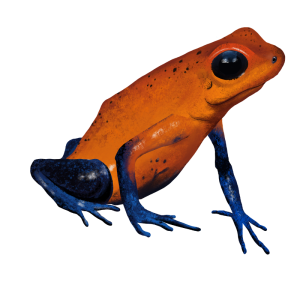
In Costa Rica, you can’t ignore them: the Oophaga pumilio. Pumilio means dwarf, and although they are barely 3 cm tall, it is hard to miss the poisonous strawberry frogs. In English, they are called Strawberry Poison Dart frogs because indigenous peoples used to use their poison to makepoison darts. They are also affectionately called the “blue jeans frog,” because they often look like red frogs in jeans. Although they are by no means all the same colors. There are some that are completely red or blue, rather yellow, green or orange, or with black stripes or dots. In total, there are some 15 to 30 color variations.
My youngest daughter Iris is studying Applied Biology in Den Bosch. I visited her at her internship site in Costa Rica, where she stayed for 5 months. I am writing a piece about this because in addition to visiting my daughter, I had the opportunity to provide first aid training for the foundation’s staff and […]
Over the past year, documentary filmmaker and dedicated foundation volunteer Bram Sturm and his crew have worked hard on a remarkable new project: Eufonia. The result is a unique and intimate glimpse into the life of Gerald, who works in the rainforest reserve of Adopteer Regenwoud. We were already deeply impressed by the outcome — and now the Wildlife Film Festival Rotterdam has confirmed it: the film has officially been selected! A truly special achievement that we’re excited to share with you.
What is deforestation anyway? This term is used to describe the process by which trees give way to agriculture and livestock. Deforestation takes place in large numbers every day, especially in the Amazon rainforest. Not a pretty thing! The consequences? Cutting down trees not only means loss of our beautiful nature and biodiversity. It has an effect on the ambient temperature: it rises. This increase is caused by burning trees and because oxygen (O2) gives way to carbon dioxide (CO2) emissions. Trees store a lot of CO2 and this is released during deforestation. The numbers? Don’t be alarmed: around 13 million hectares of forest disappear on Earth every year, according to the FAO. To make it a little more tangible: this equals 18,207,280 football fields. Approximately 34 soccer fields per second! (more…)
Despite uncertain economic times and the impact of Corona, the Foundation has some fantastic news to report. Over the past few months, we had to pull out all the stops and negotiate hard to acquire an important piece of land. And we succeeded! We were able to expand the reserve by 65 hectares, or 650,000 square meters!
And then there you are, atop a hilltop, having a good cry. Or frantically trying not to let your fellow volunteer see how touched you are. My name is Zoë, I live near Hasselt in Belgium. I am an adult education teacher, and enthusiastic but very novice when it comes to nature. I would like to tell you about my wonderful experiences as a volunteer in the reserve of Adopt Rainforest.