Zoë on her wonderful experiences as a volunteer in Costa Rica
And then there you are, atop a hilltop, having a good cry. Or frantically trying not to let your fellow volunteer see how touched you are. My name is Zoë, I live near Hasselt in Belgium. I am an adult education teacher, and enthusiastic but very novice when it comes to nature. I would like to tell you about my wonderful experiences as a volunteer in the reserve of Adopt Rainforest.
Toddler of a forest
Ivan, another volunteer who helped with the foundation’s reforestation project for three months, asked me if I wanted to go with him to the latest reforestation plot. Of course I wanted to! I had already seen the old patch where trees were planted five years ago, where, to the untrained eye, there was just a patch of rainforest to be seen, despite the fact that 5 years earlier it was bare pasture there. It seemed impossible to believe. In Belgium, where there is no shortage of rain either, a tree hardly grows in 5 years. And there I was, in a real forest. Not little shoots, but big trees, with lianas, hiding places for frogs and colorful butterflies and so much more. I have been along several times on censuses for the foundation’s long-running biodiversity study. Even though I know absolutely nothing about species identification, there is nothing like hearing a bunch of connoisseurs enthusiastically yell to each other that they see that one butterfly species they’ve only seen once, sitting further down the path there! I’ve watched the wildlife cameras placed in this newly planted forest several times, and it’s wonderful how many mammals have found their niche by now, too, in this toddler of a forest.
The Beast
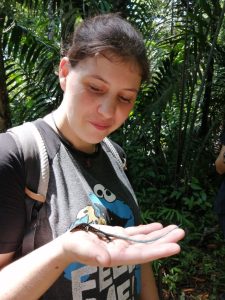
So of course I wanted to come along to the new stretch where a total of 27,800 trees are being planted. So off we went with “The Beast. And if you now imagine us galloping heroically through the jungle on the back of a jaguar with our hair in the wind, I have to disappoint you slightly. ‘The Beast’ is the car of the local local foundation, a 4×4 with some miles on the clock. The steel steed that sometimes seems to hang together from superglue, dust and good spirits, but still manages to take you to the most beautiful places without fail. The last time I rode along, there was even a salamander hitching a ride.
We drove for quite a while at 15km/h on dirt roads, stopping along the way to spot some beautiful views and birds. These included a couple of Caracara. The Caracara is a bird about half a meter tall from the falcon family. Not only impressive to see, but secretly I also found it a bit hilarious. Because the name Caracara, is like literally yelling “face-face” in Spanish at a bird.
After some driving, we left “The Beast” on the side of the road and climbed a hill. We briefly passed by Robert, who is the foreman of the group of tree planters. Both he and the eight other workers are all original inhabitants of the adjacent Indian reservation. Then we continued to the top of a hill. Along the way we saw a small tree sticking out of the ground every few meters. Still so small and fragile, no higher than your knee, as wide as your finger. Some were already being eaten by leafcutter ants, who eat an entire tree bare in no time. Again, impossible to imagine this will be a forest in 5 years, yet it is!
Natural corridor
Ivan pointed to the Barbilla National Park, the foundation’s old reserve and the recently acquired reserve. He explained how this plot where reforestation is now taking place will make the connection between the foundation’s reserve and the national park. A natural corridor for trees, plants and animals. With this corridor, there is less fragmentation, making it easier for animal species to move around in search of food or shelter. This leads to more cross-pollination and thus less inbreeding.
Hope
Anyway, so I’m standing on that hilltop with my feet in the grass, looking at the surrounding stretches of meadow and rainforest.We stopped talking, but you can’t call it quiet.It’s rarely quiet in the rainforest. You are always surrounded by birdsong, crickets, croaking frogs, calling salamanders. And in my head the news is playing in the background. Because sometimes I make the mistake of watching the news. This summer was another very pernicious one, climate-wise. One where one half of the world was on fire, and the other half flooded. My heart breaks at seeing news reports like this, and my cherished naivete that we can make everything right is sometimes hard to maintain. I hesitated for a long time about going to Costa Rica, as I have an appropriate amount of flight embarrassment, but still wanted to see all this beauty for myself. And where possible, even lend a hand. And there, on that hilltop, looking at all that potential, my heart healed itself a little. It’s hard to describe, but there, in that moment, there was suddenly a world of hope. Some 25 acres, or around 50 soccer fields of pure hope.The beauty overwhelmed me, and my eyes grew moist. Because if we can plant 27,800 trees here from a foundation founded by two Dutch guys, and already protect 240 hectares of rainforest, then anything is possible.
On the way back, I talk to Ivan about ecology, the projects the foundation is doing here and flight embarrassment. And for a moment I’m not the only one, who doesn’t quite fit into this world.No longer the only naive soul who doesn’t understand how the world always seems to go on and on, when paradise does exist and we just need to keep and restore it.
Dreams and goals
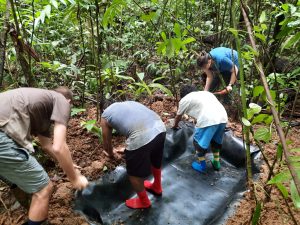
I didn’t plant any trees myself, but I did help dig three frog pools in the reserve under the expert guidance of local guides Hurben and Gerald.The first three of a total of 10 Frog Pools designed to give endangered frog species some additional habitat and breathing room.And as I push today’s tenth mosquito to death and rub off a layer of sweat, I stick my shovel into the ground once again. Because how cool is it, that 5 years from now a new group of volunteers and students will be strolling through this piece of paradise, hearing how several endangered frog species have been successfully reintroduced here. Just as I have heard all these cool stories about what the people before me have accomplished here. A chain of people, connected by that same wonder and fascination. Connected by those same dreams and goals. Connected by those same trees and plants, only about five years bigger and older. And that was exactly what my heart needed!
Would you also like to contribute as a volunteer to our project in Costa Rica? Then take a look at the website www.studytherainforest.com
For my Wildlife business management degree, I have done several internships, mostly revolving around animal care but this time I chose to visit a different type of organization. In August 2023, I landed in Costa Rica to spend 8 weeks with the research project of Adopt Rainforest.
When a butterfly flies by, most people do stop for a moment to follow it with their eyes. They often have beautiful colors and the large soft wings compared to the small body make them look almost cuddly. In Costa Rica there are more than 1200 species of butterflies and of course we are very curious about the species that occur in the reservation of Adopt Rainforest.
The mantle howler monkey is one of the largest monkeys in Central America, with males reaching a height of nearly a meter and a weight of up to 10 kg. It is one of 15 species of howler monkeys. Unfortunately, some of those species are endangered, mainly because of habitat loss and capture, for instance […]
Many people are a bit creeped out by vultures because of their specific appearance and the fact that they eat cadavers. However, vultures are indispensable to nature; they are real cleaners. Read all about vultures and why they are indispensable to the ecosystem here.
A family adventure at Adopt Rainforest by Zoë Schreurs World Family Day, also known as International Family Day, is celebrated worldwide on May 15 to recognize the value of family bonds and family relationships. This day emphasizes support, love and cooperation within families. While we at “Adopt Rainforest” are of course all a little bit […]
Critically endangered parrot species Yesterday the research program of Adopt Rainforest participated in the Censo Internacional de la Guacamaya Verde 2022. Or in English the International Sensus of the Great Green Macaw. Throughout its distribution, dozens of organisations participate in the next days to get an understanding of the current state of this parrot species. […]
This beautiful blue butterfly, measuring up to 15-20 cm, seems to appear and disappear with every flick of its wings. In fact, its underside is a clever trick of Mother Nature. On the underside, it is inconspicuous reddish-brown, with eyes to deter attackers. The bright iridescent blue, in turn, is to deter competition and attract females.
Adopt Rainforest employs a lot of volunteers who do amazing and, above all, very diverse work. In this blog post we would like to share the experiences of Annemarie, who has been volunteering for Adopt Rainforest since September 2022. (more…)
Nature lover and birdwatcher Nienke recently visited the breathtaking rainforests of Costa Rica. In the coming period, she will recount her experiences in vivid detail in a series of stories. Enjoy reading this first blog!
“When I close my eyes, I’m back there again…“ (more…)
In the spring of 2023, there was suddenly an opportunity to go to Costa Rica for Adopt Rainforest. I was also in Costa Rica a year earlier and there someone tipped me off about an organization of two Dutch guys who were working to protect and restore the rainforest. When I got home I decided […]
In 2022, we wrote an article about the international census of the Great Green Macaw (Buffon’s Macaw). Three years later, we spoke with Maarten van der Beek, founder of the foundation and research biologist at the reserve in Costa Rica. He talks about the efforts to provide a home for this beautiful bird, and with success… (more…)
This year we once again celebrated the three days of Dia del Arbol with the enthusiastic school children of our village! Check out this impression of the event, in which we highlighted this year’s theme: water. From building dams and filtering water to exploring frog pools and an exciting water obstacle course – it was […]
What’s with the fur? Why do sloths sleep so much? This month, the three-fingered sloth is the animal of the month at Adopt Rainforest. And what’s more fun than hearing from one of the founders of Adopt Rainforest some fun facts that you won’t find in a standard biology book. Maarten van der Beek is one of the biologists at Adopt Rainforest and lives on the Work With Nature reserve in Costa Rica. (more…)
Anyone who has traveled through the Americas knows them anyway, a stream of ants all carrying leaves with them. It looks like a mini highway that can go on for 30 meters. We’re talking about leaf-cutter ants of course. For tourists a source of amazement, for local farmers and vegetable gardeners a real plague that […]
In recent years we have already seen many rare and unusual animals in our reserve such as the Northern Nacked-tailed Armadillo, Black-and-White Hawk-Eagle and several felines. However, what we recently encountered is many times more interesting to scientists. In 1989, Epigomphus houghtoni, the Limon Knobtail, a dragonfly species was described by Stephen Brooks based on […]
We all know how important trees and plants are for producing oxygen and absorbing CO2. Especially lately there has been a lot of news about the climate crisis, global warming, sea level rise, CO2 offsetting and the importance of preserving trees, plants and forests. In this blog you can read some background information on how trees store our CO2 emissions.
Discover our special partnership with the Bromelia Specialist, where passion for the Bromelia plant and the conservation of Costa Rican rainforest come together. For three years, the Bromelia Specialist has supported the work of Adopteer Regenwoud in protecting the origins of the Bromelia plant, while providing Europe with the most beautiful Bromelia products. Behind the […]
We are extremely proud to tell you that the reserve has been expanded by 48.5 acres! And it is not just any expansion, it is finally the connection between the reserve of Adopt Rainforest and Barbilla National Park that we have been working towards for so long. 48.5 hectares, that’s almost 100 soccer fields and […]
More than 11 years ago, the founders of the Adopt Rainforest foundation visited this beautiful area for the first time. What a beautiful area with giant big trees, several rivers and an enormous biodiversity of plants and animals. Yet there was something they both noticed immediately. There were no monkeys at all. (more…)
At Adopteer Regenwoud, we welcome a new partner: Ecoloog op Maat B.V., an ecological consultancy firm that focuses not on enforcing legislation but on strengthening nature. In this article, we take you into the world of owner Kjetil van den Berg and his motivation for proudly calling himself a partner of the rainforest. (more…)
Nature lover and birdwatcher Nienke recently visited the breathtaking rainforests of Costa Rica. In the coming period, she will recount her experiences in vivid detail in a series of stories. Enjoy reading this second blog! There is something magical about discovering a foreign country, a feeling that you are on the verge of something bigger […]
At Adopteer Regenwoud, we’re welcoming a new partner: Ecoloog op Maat B.V., an ecological consulting firm whose focus isn’t on enforcing the law but on strengthening nature. In this article, we’ll take you into the world of owner Kjetil van den Berg and explore his reasons for proudly calling himself a partner of the rainforest. (more…)
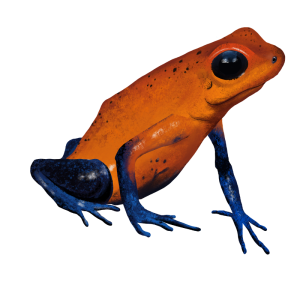
In Costa Rica, you can’t ignore them: the Oophaga pumilio. Pumilio means dwarf, and although they are barely 3 cm tall, it is hard to miss the poisonous strawberry frogs. In English, they are called Strawberry Poison Dart frogs because indigenous peoples used to use their poison to makepoison darts. They are also affectionately called the “blue jeans frog,” because they often look like red frogs in jeans. Although they are by no means all the same colors. There are some that are completely red or blue, rather yellow, green or orange, or with black stripes or dots. In total, there are some 15 to 30 color variations.
Did you know that 5% of all species of flora and fauna in the world live and grow in Costa Rica? Also, Costa Rica is in the global top 20 countries with the greatest biodiversity! Are you a real nature lover? Then put Costa Rica on your bucket list. But… before you pull your backpack and passport out of the closet, we want to give you a lesson about biodiversity. Maybe you have what it is, but to refresh your memory we’ll explain it to you in this blog. (more…)
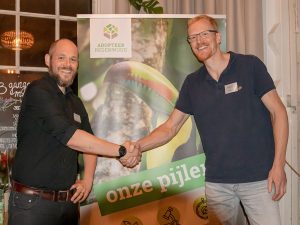
Stichting Adopteer Regenwoud’s research project is entering an exciting new phase thanks to a long-term collaboration with Utrecht University. The foundation was ready for a new step to professionalize the research project and Utrecht University was looking for a stable and reliable partner in Central America to conduct solid research in the rainforest. So for both parties this is a wonderful collaboration! Because of this we will make a big step in professionalizing our current research on biodiversity in our reserve. Together with the visiting students we will focus on scientific research in which the diversity and development of nature in our reserve, with an emphasis on flora, is central.
The Costa Ricans call him el serafín del platanar, literally translated: the little angel of the banana plantation. A nickname that perfectly suits his soft fur, calm demeanor, and almost fairy-tale-like appearance. Once you see him, you immediately understand why this little rainforest dweller is called that. (more…)
Supporting a good cause. How do you do that? There are so many charities that it is difficult to choose. To which charity do you donate money? Which charity is reliable? And where do you actually start supporting a charity? The choice is vast in the jungle of charities. If you want to support a charity, it is important that the charity suits you. Choose an organization that does things you find important. This will make donating to charity a lot easier for you. With the tips below, you can be sure that you will soon be supporting a charity in a conscious manner. (more…)
Deep in the Costa Rican rainforest, where sunlight is scarce and all manner of jungle sounds echo through the trees, lives an animal that you almost never see, but which helps maintain the balance: the ocelot. And, not least, a resident of the Adopteer Regenwoud reserve. (more…)
Costa Rica, a country of which almost half is rainforest, is a true birding paradise. More than 900 species of birds can be found here. One of the most beautiful and special birds that has its habitat in Costa Rica, however, is the Resplendent Quetzal. A good reason to go bird watching in Costa Rica!
By Zoë Schreurs The jaguar captures everyone’s imagination and has done so for ages, from North to South America. Did you know his name comes from the Guarani language of Indigenous tribes in Paraguay? It means, “He who can kill with 1 leap.” Not a bad observation, considering a jaguar can bite right through the […]
In July we told about the expansion of Adopt Rainforest’s reserve through the purchase of 48.5 acres of land. This parcel is very important because it forms a land bridge between the foundation’s current reserve and Barbilla National Park. Much of the new plot is existing forest, but there are also several acres of pasture […]
What do you give a child at the start of their life? For parents Laurens and Denise, it wasn’t a pile of gifts, but a message. A message about what really matters. About caring for the earth and looking beyond today. Their decision to set up a fundraiser for Adopt Rainforest around the birth of their children tells an inspiring story. (more…)




 on with Utrecht University. The foundation was ready for a new step to professionalize the research project and Utrecht University was looking for a stable and reliable partner in Central America to conduct solid research in the rainforest. So for both parties this is a wonderful collaboration! Because of this we will make a big step in professionalizing our current research on biodiversity in our reserve. Together with the visiting students we will focus on scientific research in which the diversity and development of nature in our reserve, with an emphasis on flora, is central.