Nienke’s story: ‘Follow the birds and discover Costa Rica’s bird paradise’
Nature lover and birdwatcher Nienke recently visited the breathtaking rainforests of Costa Rica. In the coming period, she will recount her experiences in vivid detail in a series of stories. Enjoy reading this first blog!
“When I close my eyes, I’m back there again…“
“…In the heart of an overwhelming oasis of greenery, where the rainforest embraces me like a loyal friend. The wind whispers softly, the leaves sway rhythmically to its message. The sun always finds a crack to peek through and casts one last glimpse. Evening falls, the cicadas give the signal. The rainforest of Costa Rica never sleeps—and will always remain with me.”
My name is Nienke, I am married to Patrick, and together we share a love of bird watching. Our motto: “Follow the birds and you’ll find the most beautiful places.” That brought us to Costa Rica for five weeks in the spring of 2025, the country I still dream about. In this blog, I’ll take you to one of our first birding moments during this trip: an experience that further fueled my passion.
Five weeks of intensive birdwatching requires some preparation. Standard travel guides don’t tell you where to find the Long-tailed Manakin (“you say what?!”). That’s why Richard Garrigues’ “The Birds of Costa Rica” was already worn out before we left. Our list of target species grew into a true mantra.
The moment Patrick shouted “Honey, Oropendula!” at 5:30 a.m., I knew the journey had begun. As on many mornings after that, I jumped out of bed, put on my hiking pants, and grabbed my binoculars and camera. Even though we had five weeks, it felt like we had no time to lose. I wanted to take in everything this beautiful country had to offer.
Birdwatching in the Nectar Pollen Reserve, Costa Rica
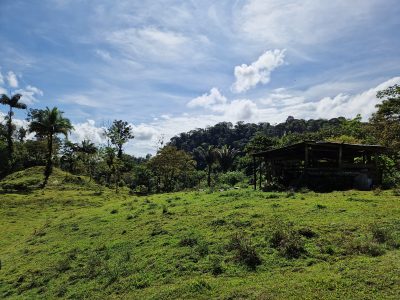
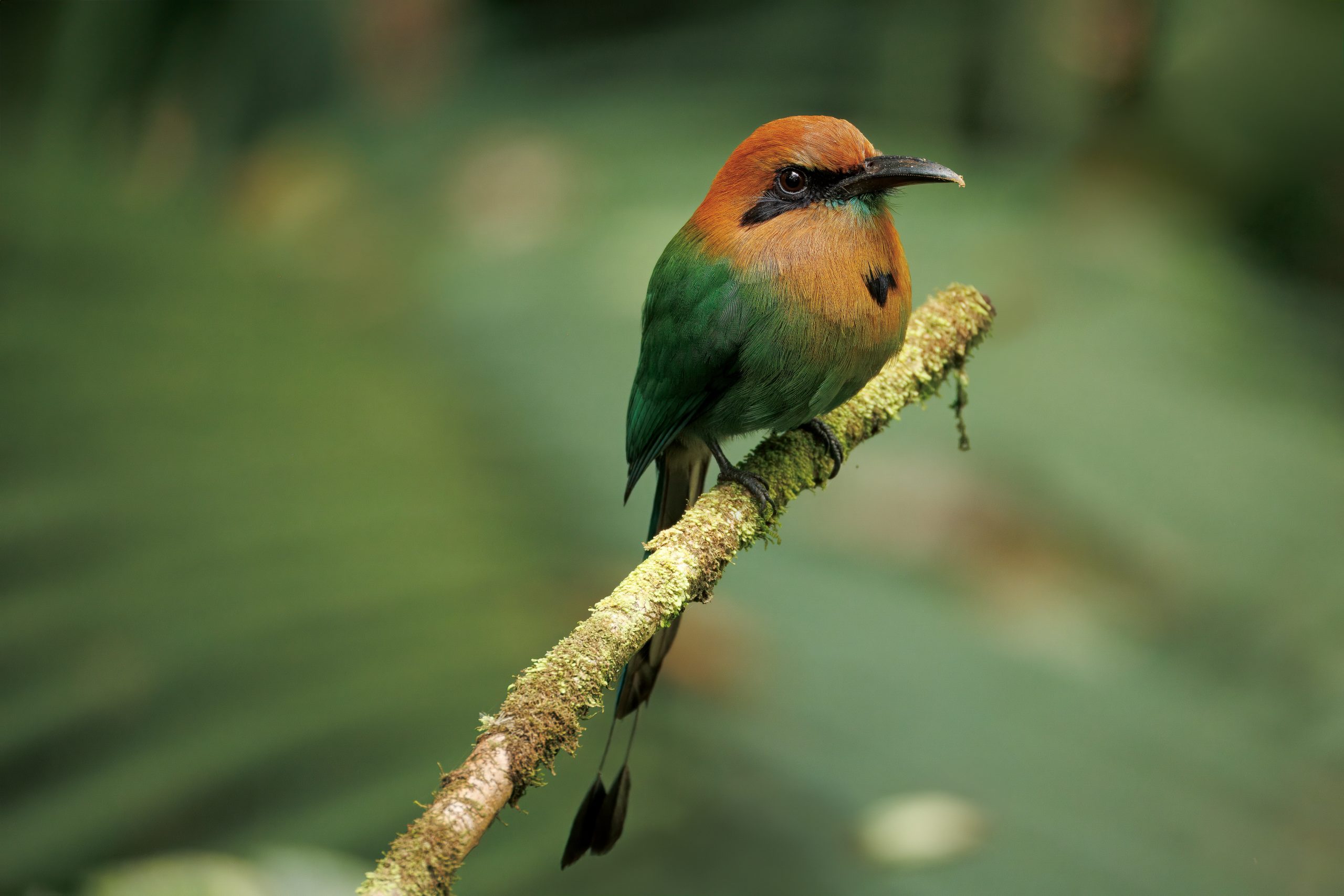
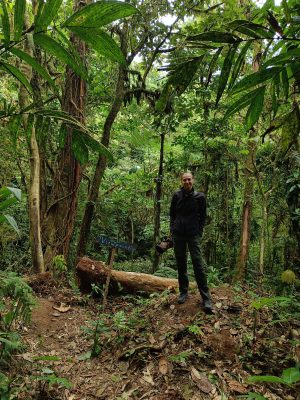
On the third day, we visited the Nectar Pollen Reserve, a private estate where more than 300 bird species have been observed via eBird. This is where my enthusiasm was ignited. Together with our guide and two local retirees, we explored the densely vegetated terrain. The birds here rarely show themselves at feeding places, so it requires real detective work. My eye was not yet trained enough to distinguish every silhouette among the greenery, but listening helped me along. That’s how we discovered a beautifully colored bird with a striking tail: the Broad-billed Motmot. This bird species hunts large insects from a fixed perch. That gave me time to observe and take pictures. That alone made the day a success for me! But we came here with one specific bird in mind.
The special encounter with the Long-tailed Tyrant
After a walk through hilly terrain, we suddenly saw it: perched on the very top of a dead tree was an elegant bird with long tail feathers and a white crown. The Long-tailed Tyrant—a flycatcher that breeds in dead trees, sometimes in abandoned woodpecker holes, and feeds on insects such as stingless bees. Our local walking companions, true bird lovers, were unaware of the existence of this bird. We stood there together, amazed and happy, enjoying this special moment. Afterwards, we exchanged contact details and shared our observations via eBird.
Birdwatching as a connection with nature and people
For us, birdwatching means more than just seeing birds: it’s about wonder, connection, sharing passion, and respect for nature. That experience in Costa Rica deepened my love for birdwatching and strengthened my commitment to nature conservation. Because caring for birds starts with caring for their habitat.
Nature lover and birdwatcher Nienke recently visited the breathtaking rainforests of Costa Rica. In the coming period, she will recount her experiences in vivid detail in a series of stories. Enjoy reading this second blog! There is something magical about discovering a foreign country, a feeling that you are on the verge of something bigger […]
And then there you are, atop a hilltop, having a good cry. Or frantically trying not to let your fellow volunteer see how touched you are. My name is Zoë, I live near Hasselt in Belgium. I am an adult education teacher, and enthusiastic but very novice when it comes to nature. I would like to tell you about my wonderful experiences as a volunteer in the reserve of Adopt Rainforest.
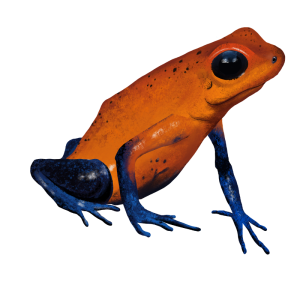
In Costa Rica, you can’t ignore them: the Oophaga pumilio. Pumilio means dwarf, and although they are barely 3 cm tall, it is hard to miss the poisonous strawberry frogs. In English, they are called Strawberry Poison Dart frogs because indigenous peoples used to use their poison to makepoison darts. They are also affectionately called the “blue jeans frog,” because they often look like red frogs in jeans. Although they are by no means all the same colors. There are some that are completely red or blue, rather yellow, green or orange, or with black stripes or dots. In total, there are some 15 to 30 color variations.
Anyone who has traveled through the Americas knows them anyway, a stream of ants all carrying leaves with them. It looks like a mini highway that can go on for 30 meters. We’re talking about leaf-cutter ants of course. For tourists a source of amazement, for local farmers and vegetable gardeners a real plague that […]
Did you know that 5% of all species of flora and fauna in the world live and grow in Costa Rica? Also, Costa Rica is in the global top 20 countries with the greatest biodiversity! Are you a real nature lover? Then put Costa Rica on your bucket list. But… before you pull your backpack and passport out of the closet, we want to give you a lesson about biodiversity. Maybe you have what it is, but to refresh your memory we’ll explain it to you in this blog. (more…)
Costa Rica, a country of which almost half is rainforest, is a true birding paradise. More than 900 species of birds can be found here. One of the most beautiful and special birds that has its habitat in Costa Rica, however, is the Resplendent Quetzal. A good reason to go bird watching in Costa Rica!
Critically endangered parrot species Yesterday the research program of Adopt Rainforest participated in the Censo Internacional de la Guacamaya Verde 2022. Or in English the International Sensus of the Great Green Macaw. Throughout its distribution, dozens of organisations participate in the next days to get an understanding of the current state of this parrot species. […]
Many people are a bit creeped out by vultures because of their specific appearance and the fact that they eat cadavers. However, vultures are indispensable to nature; they are real cleaners. Read all about vultures and why they are indispensable to the ecosystem here.
Humanity has cleared countless acres of forest over the centuries. But not all forests are the same. Sure, a forest in Costa Rica has trees and squirrels, just like a forest here in Europe. But while we can certainly draw comparisons between our temperate forests and tropical forests, there are many differences. In this blog post, we take a closer look at why tropical rainforest logging is even more disastrous and how the consequences extend much further. And logging is certainly ongoing. Globally, the tropics lost 4.1 million hectares of primary forest in 2022, 10% more than in 2021, the platform Global Forest Watch reported.(more…)
More than 11 years ago, the founders of the Adopt Rainforest foundation visited this beautiful area for the first time. What a beautiful area with giant big trees, several rivers and an enormous biodiversity of plants and animals. Yet there was something they both noticed immediately. There were no monkeys at all. (more…)
This beautiful blue butterfly, measuring up to 15-20 cm, seems to appear and disappear with every flick of its wings. In fact, its underside is a clever trick of Mother Nature. On the underside, it is inconspicuous reddish-brown, with eyes to deter attackers. The bright iridescent blue, in turn, is to deter competition and attract females.
When a butterfly flies by, most people do stop for a moment to follow it with their eyes. They often have beautiful colors and the large soft wings compared to the small body make them look almost cuddly. In Costa Rica there are more than 1200 species of butterflies and of course we are very curious about the species that occur in the reservation of Adopt Rainforest.
The mantle howler monkey is one of the largest monkeys in Central America, with males reaching a height of nearly a meter and a weight of up to 10 kg. It is one of 15 species of howler monkeys. Unfortunately, some of those species are endangered, mainly because of habitat loss and capture, for instance […]
By Zoë Schreurs The jaguar captures everyone’s imagination and has done so for ages, from North to South America. Did you know his name comes from the Guarani language of Indigenous tribes in Paraguay? It means, “He who can kill with 1 leap.” Not a bad observation, considering a jaguar can bite right through the […]
Most species are between 7.5 and 13 cm in size. You would almost think it is an out-sized bumblebee! Hummingbirds (Trochilidae) are the smallest birds in the world. They are a family of birds of the order swift-like. The family includes more than 300 species. Most species are found in South America. It is so much fun (more…)
Adopt Rainforest employs a lot of volunteers who do amazing and, above all, very diverse work. In this blog post we would like to share the experiences of Annemarie, who has been volunteering for Adopt Rainforest since September 2022. (more…)
What do you give a child at the start of their life? For parents Laurens and Denise, it wasn’t a pile of gifts, but a message. A message about what really matters. About caring for the earth and looking beyond today. Their decision to set up a fundraiser for Adopt Rainforest around the birth of their children tells an inspiring story. (more…)
What’s with the fur? Why do sloths sleep so much? This month, the three-fingered sloth is the animal of the month at Adopt Rainforest. And what’s more fun than hearing from one of the founders of Adopt Rainforest some fun facts that you won’t find in a standard biology book. Maarten van der Beek is one of the biologists at Adopt Rainforest and lives on the Work With Nature reserve in Costa Rica. (more…)
In 2022, we wrote an article about the international census of the Great Green Macaw (Buffon’s Macaw). Three years later, we spoke with Maarten van der Beek, founder of the foundation and research biologist at the reserve in Costa Rica. He talks about the efforts to provide a home for this beautiful bird, and with success… (more…)
In recent years we have already seen many rare and unusual animals in our reserve such as the Northern Nacked-tailed Armadillo, Black-and-White Hawk-Eagle and several felines. However, what we recently encountered is many times more interesting to scientists. In 1989, Epigomphus houghtoni, the Limon Knobtail, a dragonfly species was described by Stephen Brooks based on […]



 Birdwatching in the Nectar Pollen Reserve, Costa Rica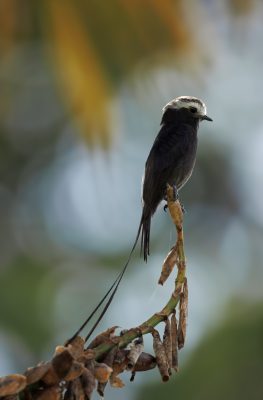
 Birdwatching as a connection with nature and people